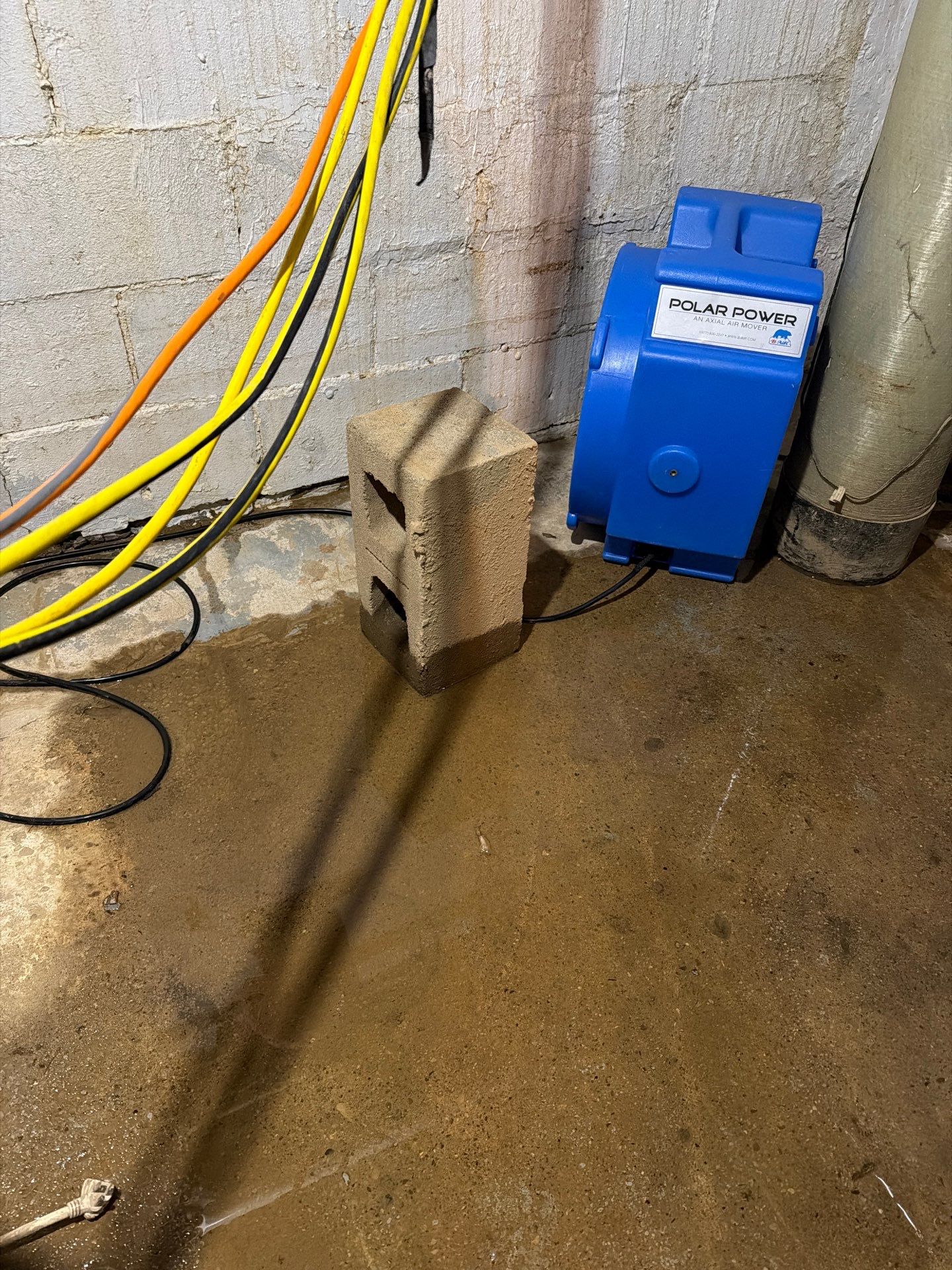
Step 1: Source Identification and Water Categorization
- Stop the source. Shut the main water valve, isolate the supply line, or place a bucket under an active drip before anything else.
- Classify the water. Clean supply line break is Category 1. Dishwasher overflow, washing machine discharge, or aquarium water is Category 2. Sewage, toilet trap-seal water, or floodwater from outside is Category 3.
- Document everything. Take 15 to 20 photos and a 60-second video before any extraction begins. Insurance adjusters want pre-mitigation evidence.
- Note the timestamp. The 24, 48, and 72 hour clocks all start at the moment of contact, not the moment of discovery.
- Check for category escalation. Category 1 water becomes Category 2 after 48 hours of contact with building materials. Category 2 becomes Category 3 after 72 hours. Van Buren Water Restoration technicians flag escalation risk during the first call.
Step 2: Initial Inspection and Moisture Mapping
- Technician arrives with a Protimeter or Tramex meter, thermal imaging camera, and hygrometer.
- Moisture readings are taken every 4 to 6 feet across the affected carpet, plus 2 feet into adjacent dry zones.
- Subfloor readings are pulled through pin probes at the tackless strip line.
- Ambient temperature target: 70 to 90 degrees F. Relative humidity target: under 60 percent during drying.
- A moisture map is drawn and logged. This becomes the baseline for daily monitoring.
- Affected square footage is calculated to the nearest 10 sq ft and recorded on the work authorization.
- Adjacent materials (drywall, baseboard, door casing, cabinet toe-kicks) are probed for wicking damage.
If hidden moisture is suspected behind baseboards or under cabinets, our hidden leak detection process uses thermal imaging and cavity probes to confirm.
Step 6: Structural Drying Setup
- Air movers: 1 unit per 10 to 16 linear feet of wall, angled at 15 to 45 degrees to the carpet surface.
- Dehumidifiers: 1 LGR (low-grain refrigerant) dehu per 500 to 1,000 sq ft of affected area, sized to the calculated load.
- Float drying: carpet edge is lifted at one corner and air movers blow underneath the carpet onto the subfloor.
- Runtime: 3 to 5 days for most Category 1 jobs. Longer for dense pad or hardwood transitions.
- Equipment cost: $35 to $75 per air mover per day, $85 to $130 per dehumidifier per day.
- Power load check: a 200 sq ft room with 4 air movers and 1 LGR pulls roughly 15 to 18 amps. Circuits are mapped before plug-in to avoid breaker trips.
- Containment: 6-mil poly is hung at room thresholds to reduce drying chamber volume and cut dehumidifier runtime by 20 to 30 percent.
Insurance Documentation Checklist
- Cause of loss statement signed by the homeowner at the first visit.
- Daily drying logs with moisture readings, equipment counts, and technician initials.
- Photo set at intake, mid-drying (day 2), and final (post-equipment removal).
- Equipment list with serial numbers and hours run, billed per IICRC-aligned line items.
- Final moisture certificate confirming subfloor and adjacent materials reached dry standard.
Step 8: Re-Installation or Replacement Decision
- Salvageable carpet: re-stretch, re-seam at doorways, replace pad. $1.00 to $2.50 per sq ft.
- Non-salvageable: full replacement. New carpet and pad install runs $3.50 to $8.00 per sq ft installed in Van Buren depending on grade.
- Delamination of the carpet backing is an automatic replacement trigger.
- Visible staining, odor after drying, or Category 2 or 3 exposure means replacement.
- Berber and looped constructions tolerate re-stretching better than plush cut-pile after a soaking event.
Step 4: Pad Decision (Salvage or Remove)
- Category 1, under 24 hours: pad may be dried in place with floating method and air movers underneath.
- Category 1, 24 to 48 hours: pad removal is usually faster and cheaper than in-place drying.
- Category 2: pad is removed and discarded. Always. No exceptions per IICRC S500.
- Category 3: carpet AND pad are removed, bagged, and disposed of as contaminated waste.
- Pad removal and haul-away: $0.75 to $1.50 per square foot.
- Pad type matters. Bonded urethane (rebond) holds 3 to 5 times its weight in water. Frothed foam and rubber slab pads release water faster but cost more to replace.
Step 3: Extraction
- Truck-mounted extraction pulls 90 to 95 percent of standing water from carpet fibers at roughly 200 PSI and 150 inches of water lift.
- Weighted extraction tools (rovers) are used for saturated pad without immediate pad removal. One pass per square foot at minimum.
- Volume estimate: a 200 sq ft room with saturated carpet and pad holds roughly 25 to 50 gallons of water.
- Extraction time: 30 to 90 minutes for a typical residential room.
- Cost range: $0.50 to $1.25 per square foot for extraction alone.
- Portable extractors are used for upper-floor jobs where hose runs exceed 150 feet. Lift drops to roughly 120 inches but mobility is faster.
Total Cost Ranges for Van Buren Homeowners
- Small room, Category 1, dried in place: $500 to $1,200
- Average room with pad replacement: $1,200 to $2,800
- Multi-room Category 2 event: $2,500 to $6,000
- Full Category 3 carpet and pad removal with subfloor treatment: $4,000 to $9,000+
- Whole-floor flood with hardwood transitions and cabinet kick removal: $7,500 to $15,000
If the event came from a sewage source, the protocol shifts entirely. See our Category 3 toilet overflow walkthrough for the specific steps. For broader pricing context across the whole job type, the complete water damage restoration cost breakdown covers structural and content categories together.
Step 5: Antimicrobial Application
- EPA-registered antimicrobial is applied to the backing and subfloor after extraction.
- Application rate: per manufacturer label, typically 1 gallon per 200 to 400 sq ft.
- Dwell time: 10 minutes minimum before drying begins.
- Cost: $0.25 to $0.50 per square foot.
- Products used: quaternary ammonium compounds for Category 1 and 2, hospital-grade botanical or phenolic for Category 3.
Step 7: Daily Monitoring
- Technician returns every 24 hours to take moisture readings at the same mapped points.
- Equipment placement is adjusted based on drying progress.
- Subfloor must reach within 4 percentage points of dry standard before equipment removal.
- Documentation is logged for insurance: psychrometric readings, photos, equipment hours.
- Grain depression (indoor vs outdoor) is calculated daily. A 30 to 40 grain spread confirms the dehumidifier is pulling load.
- If readings plateau for 48 hours, the drying plan is revised. Common fixes: add a second dehu, raise chamber temperature 5 degrees, or pull baseboard for cavity drying.